
Travel without academic architecture
Cohorts return with photographs and goodwill, but no defensible link between the itinerary and the course outcomes it was meant to serve.

Feelivacation Global Learning
We design, curate and execute faculty-led immersion programmes for universities, business schools and premium schools — built around stated academic outcomes, credible host access and evidence your institution can defend.
20–0
Students per cohort
7–0 days
Programme duration
12–0 wks
Planning lead time
0-point
Readiness index
The problem
Not because destinations are wrong, but because the programme was never designed as academic work in the first place.
Cohorts return with photographs and goodwill, but no defensible link between the itinerary and the course outcomes it was meant to serve.
Campus visits become lobby tours. Industry exposure becomes a brochure presentation. Nothing is observed closely enough to be analysed.
Accreditation panels, boards and parents ask what changed. Without rubrics, journals or a capstone, the answer stays anecdotal.
Visas, medical disclosure, rooming, minors, movement and escalation land on academic staff who were hired to teach, not to run field operations.
Every year restarts from zero because the design lived in a vendor's inbox rather than in the institution's own programme architecture.
“The destination creates attention. The learning design converts attention into capability.”
The model
Six disciplines of work sit behind every cohort we run. The institution owns the output.
We start with the institution: graduate attributes, course outcomes, accreditation language, cohort profile and what the department must be able to evidence afterwards.
One primary academic track and up to two supporting tracks. Every site visit is mapped to a stated learning outcome, a challenge brief and a journal prompt.
Universities, innovation precincts, industry hosts, conservation organisations and cultural custodians — confirmed sessions, not walk-through visits.
Accommodation, ground movement, meals, daily attendance, medical and dietary process, emergency escalation and institutional communication.
Faculty rubric, reflective journal, capstone presentation and an optional cohort readiness index measured before and after the programme.
A documented, repeatable programme architecture the institution owns — designed to run again annually with a stronger rubric each cycle.
Who we work with
Internationalisation offices and deans building experiential credit-linked cohorts.
MBA and BBA programmes needing global exposure with defensible learning outcomes.
Engineering, architecture, hospitality, healthcare and sciences departments.
Senior-school leadership, global citizenship and sustainability cohorts.
What this is not: Feelivacation Global Learning is not a study abroad consultancy, admissions counselling service, degree placement agency or migration advisor. We do not represent universities for enrolment and we do not advise students on study visas.
Employability
Programmes target eight capability dimensions and convert field experience into observable evidence students can use in portfolios, interviews and assessment.
Question assumptions, compare systems and interpret evidence rather than impressions.
Ask informed questions, listen, synthesise and present a concise evidence-based argument.
Work across viewpoints and responsibilities under real time constraints.
Take initiative, make decisions and adjust when conditions or information change.
Navigate unfamiliar values, protocols and perspectives with curiosity and respect.
Frame a problem, generate options, weigh trade-offs and test solution logic.
Prepare, meet commitments and engage appropriately with academic and industry hosts.
Connect environment, culture, community, policy and economics instead of treating them separately.
Observe
Structured field notes and questions
Interpret
Compare theory against context
Apply
Challenge brief and solution logic
Demonstrate
Capstone and portfolio artefact
No fabricated promise. The programme is designed to support employability development. Any claimed uplift is reported only after a cohort's actual baseline, post-programme and faculty-assessed results are available.
Measurement
An optional 100-point institutional scorecard, measured before and after the programme. A developmental tool for the cohort — not a psychometric test, an academic grade or an employment guarantee.
| Dimension | Weight | What is assessed | Evidence source |
|---|---|---|---|
| Critical thinking | 15 | Interpretation of evidence, comparison of systems | Field audit + journal |
| Communication | 15 | Structure, clarity, audience awareness | Q&A + presentation |
| Teamwork | 12 | Contribution, listening, conflict management | Peer / faculty rubric |
| Leadership | 12 | Planning, role clarity, judgement, adaptability | Field task + peer evidence |
| Global competence | 12 | Respect, curiosity, context and adaptation | Reflection + conduct |
| Innovation | 12 | Problem definition, options, feasibility | Capstone |
| Professionalism | 10 | Preparation, commitments, host engagement | Faculty observation |
| Self-development | 12 | Changed assumptions and future application | Learning journal |
T-2 weeks — Baseline
Self-assessment and short scenario task
Student and faculty
During travel
Learning journal, participation and field tasks
Faculty / facilitator
Final day — Capstone
Team presentation against a standard rubric
Faculty + invited reviewer
T+1 week — Post score
Reflection, self-assessment and faculty evaluation
Student and faculty
T+60 days — Transfer
Evidence used in project, interview or campus initiative
Career services / faculty
Illustrative weights. Institutions may adapt dimensions and rubrics to their graduate attributes, accreditation needs or programme objectives — or replace the index with their own framework entirely.
Destination programmes
Two destinations we operate with depth. Additional destinations are developed on institutional request where credible academic and industry access can be confirmed.

Australia
Innovation, liveable cities and applied enterprise
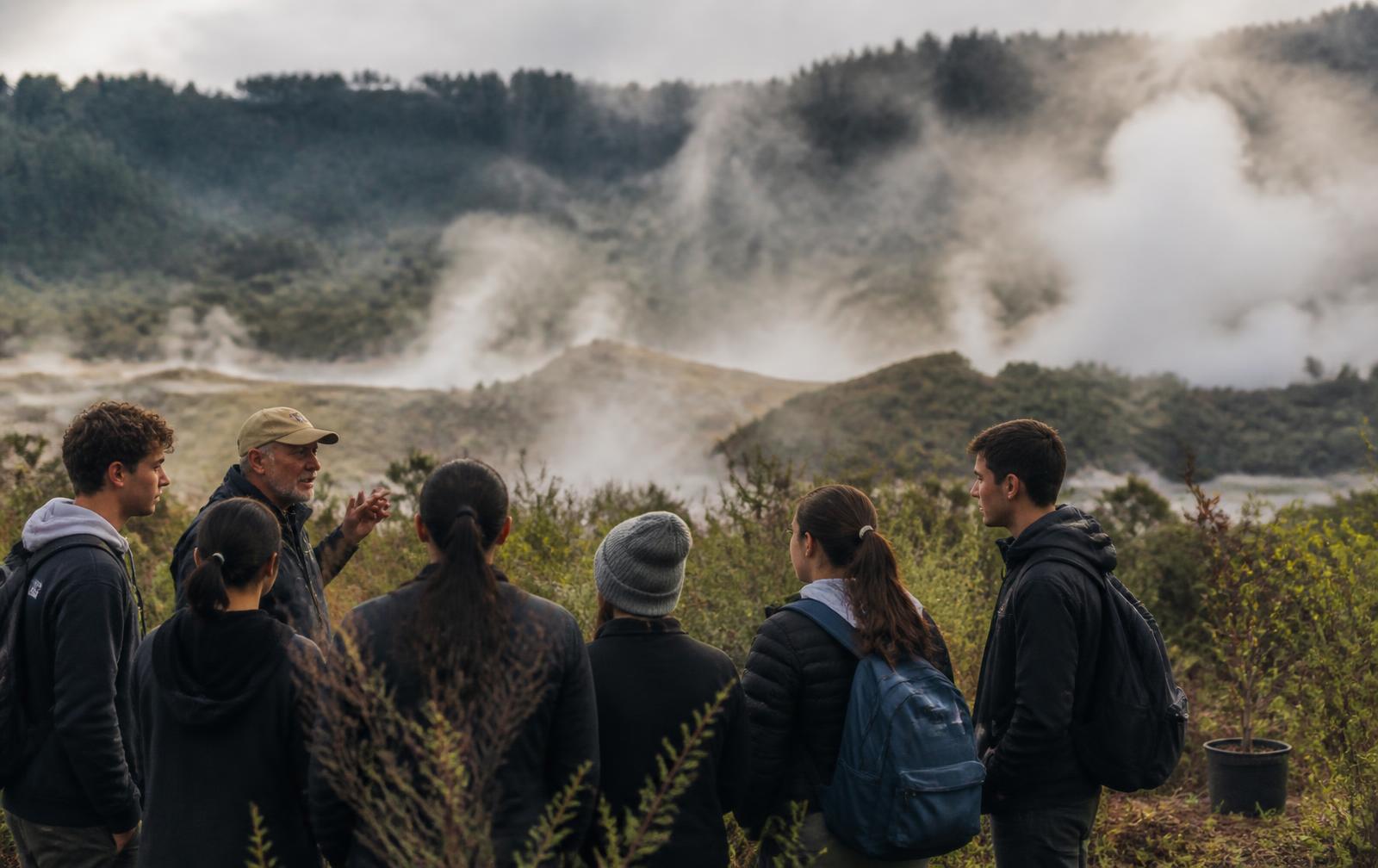
New Zealand
Regenerative systems, indigenous knowledge and public policy
Academic depth
A programme that tries to serve every discipline serves none. We select a primary academic track with the faculty and support it with at most two adjacent ones.
MBA / BBA / Commerce
Innovation strategy and commercialisation · Start-up and scale-up ecosystems · Consumer and services markets · India–Australia business comparison
Engineering & technology
AI and smart systems in the built environment · Infrastructure and mobility systems · Applied research to industry translation · Responsible technology deployment
Architecture & urban design
Density, laneways and the public realm · Adaptive reuse and heritage tension · Liveability metrics and their limits · Climate-responsive urban strategy
Hospitality, tourism & MICE
Events and business-tourism economics · Service design and guest experience · Precinct-led destination management · Workforce and sustainability pressures
Healthcare & allied sciences
Health service design and access · Preventive and community health models · Innovation in care delivery · Comparative system reflection
Tourism, hospitality & destination management
Destination stewardship · Māori tourism and cultural integrity · Visitor experience and operational design · Hospitality sustainability and workforce issues
Agriculture, food systems & rural enterprise
Land, water and food-system trade-offs · Agri-innovation and value chains · Community enterprise models · Environmental responsibility
Public policy, culture & social sciences
Institutions, identity and public narratives · Indigenous knowledge and ethical engagement · Community participation · Comparative policy reflection
Environment, conservation & sciences
Restoration ecology and closed-system conservation · Biodiversity measurement and reporting · Climate adaptation in practice · Science communication to the public
Leadership & senior-school cohorts
Global citizenship and future careers · Outdoor teamwork and reflection · Cultural intelligence and responsible travel · Project-based sustainability challenge
Impact
Pilot
One department, 20–30 students
Repeat
Annual cohort with an improved rubric
Expand
Multiple disciplines and faculty tracks
Network
Hosts, alumni and institutional partners
The long-term asset is not a seven-day tour. It is a repeatable global-learning platform owned by the institution.
Scope
The signed proposal lists exact quantities, categories, host fees and meal plan. The following is the recommended base scope.
Pricing: programmes are quoted institutionally against the signed scope — cohort size, destination, duration, accommodation category, host fees and meal plan. There is no published per-student rate card.
Engagement
Feelivacation designs, contracts and executes the entire programme end to end.
Best for: Institutions running their first international cohort, or scaling to multiple departments.
Faculty lead the academics; Feelivacation builds the architecture and evidence framework.
Best for: Departments with strong faculty leadership seeking rigour and structure.
The institution owns the curriculum; Feelivacation owns execution and duty of care.
Best for: Institutions with an existing curriculum that need dependable ground execution.
Governance
Institutions carry reputational and legal responsibility for every cohort. Our operating protocol is documented, not improvised.
Written escalation matrix, named on-ground contacts and a defined institutional communication line before departure.
Medical, dietary, allergy and emergency-contact information collected and held under a defined access protocol.
Daily attendance, movement plans and headcount discipline at every transition point.
Guided documentation with realistic lead times. We do not promise visa outcomes — decisions rest with sovereign authorities.
Engagement with indigenous and community hosts follows their protocols, consent and compensation norms.
Academic judgement, assessment and student discipline remain with the institution at all times.
Planning
Realistic lead times protect host quality, visa comfort and student readiness.
Week 0
Objectives, cohort profile, discipline track, budget envelope and internal approvals.
Week 1–2
Draft learning outcomes, destination logic, host shortlist and indicative costing.
Week 3–4
Signed proposal with exact inclusions, host fees, meal plan and payment schedule.
Week 5–8
Registrations, documentation, visa filing, insurance and rooming.
Week 9–12
Student and parent orientation, challenge brief release and faculty rubric handover.
Travel
Daily academic delivery, field tasks, journals and capstone presentation.
T+30 days
Cohort outcome summary, evidence pack and recommendations for the next cycle.
Universities & business schools
12–16 weeks lead time
Premium schools & senior-school cohorts
16–20 weeks lead time
Questions
Feelivacation Global Academy
The Global Academy runs experiential travel education — a 7-day Field Lab, a 90-day Professional Accelerator and an 11-month School of Travel Practice. Same field-learning philosophy, applied to professional formation.
Explore the Global AcademyInstitutional enquiry
Tell us the cohort, the discipline and what your institution needs to evidence. We respond within one working day with an indicative programme architecture.
Prefer email? globallearning@feelivacation.com