
New Zealand academic immersion setting for institutional student cohorts
    Global Learning

    New Zealand · Faculty-led immersion

    New Zealand Global Immersion Programme

    Regenerative systems, indigenous knowledge and public policy

    Duration
    8 days / 7 nights
    Cohort size
    20–35 students
    Bases
    Auckland · Rotorua · Wellington
    Lead time
    12–16 weeks
    Request this programme

    Why this destination

    New Zealand is one of the few places where conservation, indigenous knowledge, tourism economics and public policy can be studied as a single connected system within one week. The three-base route is deliberate: enterprise in Auckland, cultural and environmental stewardship in Rotorua, policy and national narrative in Wellington.

    Regenerative tourism as an operating model

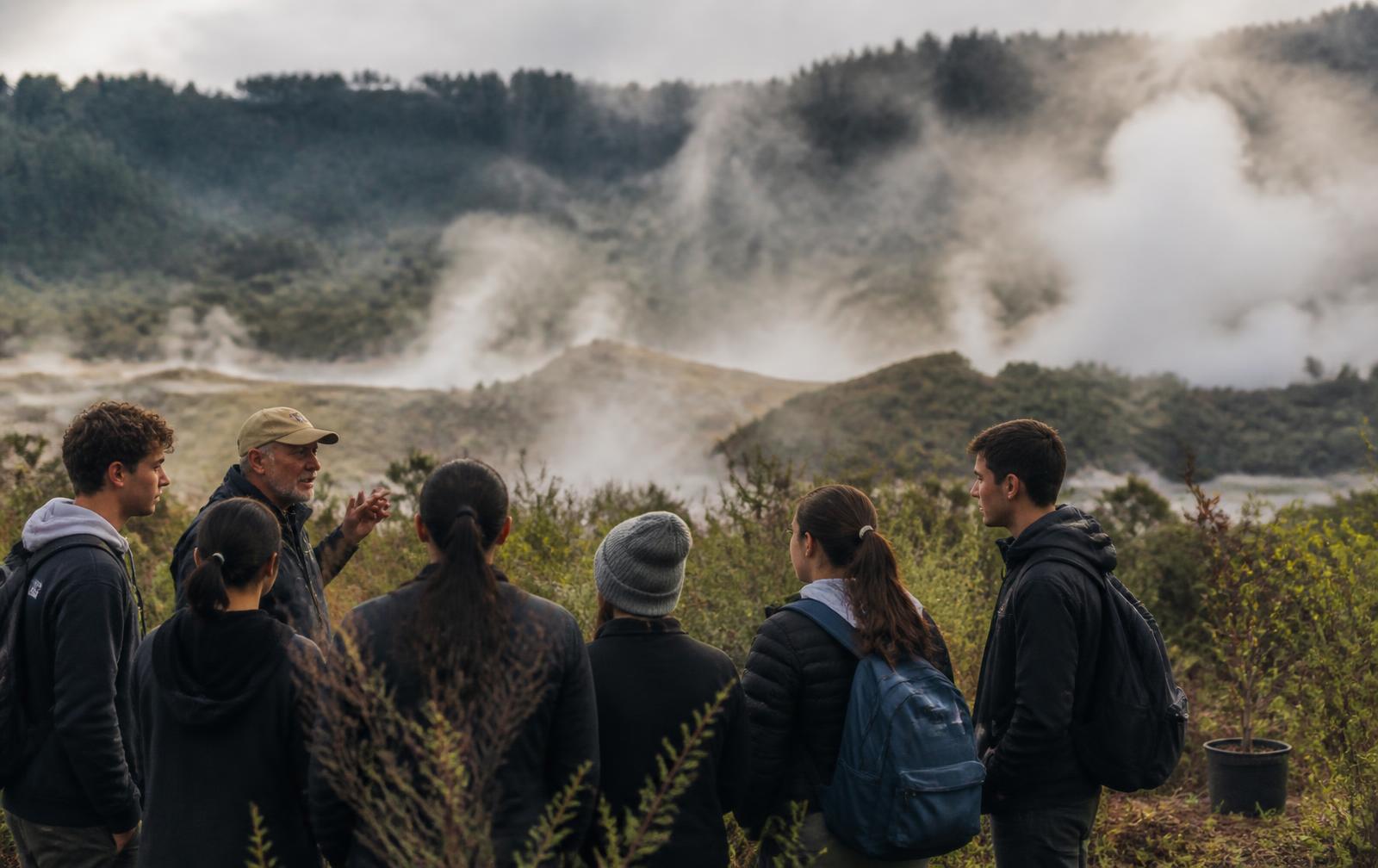
    Destination stewardship here is measurable and contested — students see the trade-offs, not the marketing.
    Māori knowledge as intellectual framework

    Te Puia and cultural custodians provide indigenous knowledge under their own protocols, framed as a system of thinking rather than a cultural show.

    Conservation you can audit

    Zealandia offers a rare closed-system conservation model where restoration outcomes are documented and debated.

    Policy and national identity in one capital

    Te Papa and Wellington institutions let students trace how a country narrates itself and legislates for its environment.

    Professional horticulture delegations

    For agricultural universities, public institutions, industry associations and agribusiness leaders, explore a tailored horticulture and agritech learning brief. Technical engagements remain subject to suitability, permission and written host confirmation.

    New Zealand horticulture & agritech delegations

    Discipline pathways

    The programme should not attempt to cover every pathway in one cohort. Feelivacation and faculty select one primary academic track and up to two supporting tracks.

    Tourism, hospitality & destination management

    • Destination stewardship
    • Māori tourism and cultural integrity
    • Visitor experience and operational design
    • Hospitality sustainability and workforce issues

    Agriculture, food systems & rural enterprise

    • Land, water and food-system trade-offs
    • Agri-innovation and value chains
    • Community enterprise models
    • Environmental responsibility

    Public policy, culture & social sciences

    • Institutions, identity and public narratives
    • Indigenous knowledge and ethical engagement
    • Community participation
    • Comparative policy reflection

    Environment, conservation & sciences

    • Restoration ecology and closed-system conservation
    • Biodiversity measurement and reporting
    • Climate adaptation in practice
    • Science communication to the public

    Leadership & senior-school cohorts

    • Global citizenship and future careers
    • Outdoor teamwork and reflection
    • Cultural intelligence and responsible travel
    • Project-based sustainability challenge

    Illustrative programme flow

    The final sequence is set with faculty during programme architecture. Host sessions are confirmed in writing before the signed proposal.

    Day 1

    Orientation

    Auckland — arrival & framing

    • Arrival, transfer and cohort settling
    • Programme framing, rubric and challenge brief
    • City orientation and safety protocol
    • Faculty-led expectation setting

    Day 2

    Primary track

    Auckland — innovation & enterprise

    • University innovation and maker-space session
    • Enterprise or industry host dialogue
    • Urban and harbour systems observation
    • Structured field notes and journal prompt

    Day 3

    Transition & context

    Auckland → Rotorua

    • Scenic transfer with en-route landscape reading
    • Regional economy and land-use briefing
    • Evening reflection circle
    • Team problem framing

    Day 4

    Cultural intelligence

    Rotorua — Māori knowledge & geothermal systems

    • Cultural centre session under host protocols
    • Geothermal and environmental systems field study
    • Cultural integrity in tourism discussion
    • Evidence consolidation

    Day 5

    Sustainability literacy

    Rotorua — regenerative tourism & community enterprise

    • Destination stewardship case session
    • Community enterprise and workforce dialogue
    • Trade-off and feasibility workshop
    • Leadership and teamwork field task

    Day 6

    Policy transition

    Rotorua → Wellington

    • Transfer to the capital
    • National narrative and museum-based policy study
    • Comparative India–New Zealand discussion
    • Capstone drafting

    Day 7

    Systems thinking

    Wellington — conservation & policy

    • Closed-system conservation sanctuary field audit
    • Policy, institutions and public participation session
    • Capstone rehearsal
    • Faculty checkpoint on rubric evidence

    Day 8

    Assessment

    Capstone & close

    • Team capstone presentations to faculty and invited reviewer
    • Rubric scoring and structured feedback
    • Reflection, participation recognition and close
    • Departure transfers

    Learning outcomes & assessment

    On completion, students can

    • Explain how environment, culture, community, policy and economics interact in one system
    • Evaluate a regenerative tourism or conservation model against its stated claims
    • Engage with indigenous knowledge respectfully and represent it accurately
    • Convert field observation into a structured problem, options and recommendation
    • Identify how personal assumptions changed and what evidence supports the change

    Capstone structure

    • Sustainability or stewardship challenge brief issued before departure
    • Field audit evidence gathered across three bases
    • Final presentation to faculty and an invited external reviewer
    • Scored on a shared rubric mapped to the institution's graduate attributes

    What is included

    The signed proposal lists exact quantities, categories, host fees and meal plan for your cohort.

    Programme & learning design

    • Institutional discovery and learning-outcome mapping
    • Discipline-specific programme architecture
    • Challenge brief, journal prompts and faculty rubric
    • Coordination of confirmed academic and expert sessions
    • Culture, conservation and leadership modules
    • Capstone framework and participation recognition

    Travel & destination operations

    • Accommodation in the agreed contracted category
    • Airport transfers and all programme ground movement
    • Agreed meal plan across the programme
    • Entrance fees and confirmed experience costs
    • Dedicated on-ground programme coordination
    • 24×7 destination support for the cohort

    Student coordination & readiness

    • Student data and rooming templates
    • Visa-documentation guidance and tracking
    • Medical, dietary and emergency-information process
    • Pre-departure student and parent orientation
    • Daily movement and attendance support
    • Emergency escalation and institutional communication

    Quoted separately

    • International airfare and applicable taxes
    • Visa government fees and biometrics
    • Travel and medical insurance premiums
    • Host institution or expert session fees, where charged
    • Personal expenses and optional add-on experiences
    • Anything not explicitly listed in the signed proposal

    Programmes are quoted institutionally against the signed scope. Visa decisions rest entirely with sovereign authorities; Feelivacation guides documentation but does not promise outcomes.

    Institutional enquiry

    Discuss a New Zealand cohort.

    Share your discipline focus, cohort size and travel window. We respond within one working day.

    Institutional enquiries only. We respond within one working day with a discovery call slot. No student admissions or study-abroad counselling is offered.

    Prefer email? globallearning@feelivacation.com